
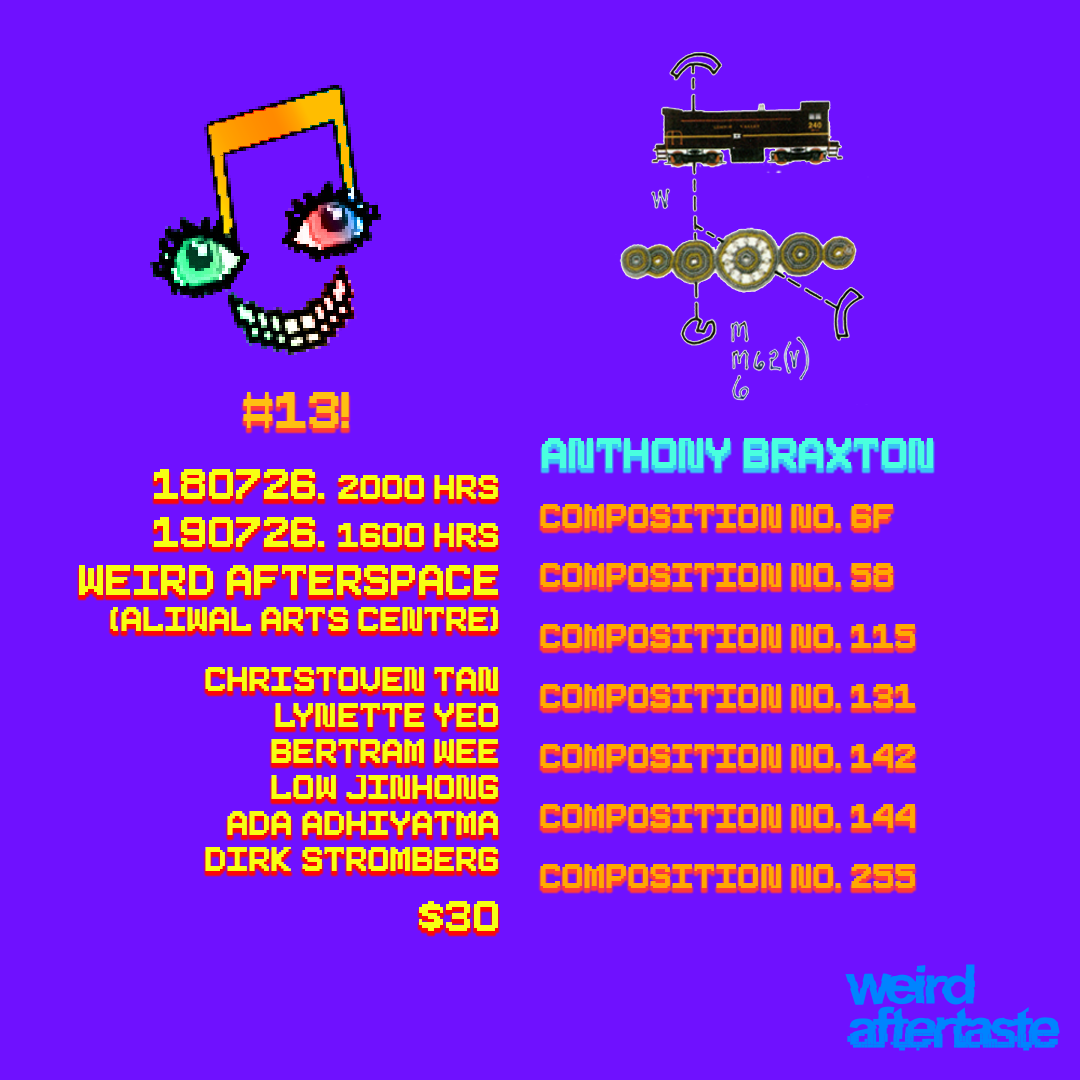

Anthony Braxton's music has been a force in my life ever since I first heard it in 2013. It wasn't immediate, but it called me back again and again with its intellectual rigor, humour, its insistence on always being slightly in the wrong context, and its beautiful grasp of melody, shape and structure. For a young musician frustrated by the jazz world's inertial machismo and by the institutional stupor of the postwar avant-garde, Braxton - and the Association for the Advancement of Creative Musicians (AACM), of which he was an early member - was a light in the fog. Here was a music where the 'revolutionary' promise of experimental music was in the process of being made real, in its egalitarianism and its commitment to both rigorous exploration and fun.
So to be able to present this to you, today, feels like a homecoming of sorts, and I am so thrilled to be able to share the results of our practice. The sounds you hear are, as per the composer's intentions, as much a product of our individual histories and trajectories as musicians as they are a product of the scores we are reading.
These notes will provide a short description of the pieces to be performed, interspersed with excerpts from Anthony Braxton's performance notes and speeches. I think those may give a better flavour of what is going on than anything I could write.
- Ada Adhiyatma
The body of "musics" that make up this Catalogue of Works represent the "best I could do" when confronted with the incredible gifts of beauty that the Masters have given us in the phenomenon we call music. I perceive this effort as an evolving MULTI-LOGIC sound universe that demonstrates sonic unification on three primary planes of perception dynamics—abstract realization, concrete realization and intuitive realization. All of these matters are part of the wonderful world of sound wonder and beauty—I am so grateful for music and the "act of thinking about music/feeling". Life on earth would be impossible without music—our species could not exist without love and compassion. All of these matters are related.
(Introduction to Catalog of Works, 1988)
COMPOSITION NO. 131 (1986)
COMPOSITION NO. 144 (1988)
The most important feature of the body of material that must first be understood is that this information represents the vibrational fluid and atomic structural ingredients of one dynamic sound state (intention). […] Every part can also be utilized (or "adopted") by any instrument or instrumentation.
(Introduction to Catalog of Works, 1988)
When working with Braxton’s scores, the printed music exists only as the “primary imprint reality of a given form—as viewed from its origin/identity instrumentation.” That is to say, the music is often conceived for specific instrumentations, depending on the context for which it was written. The materials in 131 and 144 were originally conceived for more traditional jazz constellations, often complete with some form of rhythm section. With the core WA quartet’s idiosyncratic (and decidedly un-jazzy) instrumentation, the work is reconfigured for this alternative ‘reality context’, with its sonic fabric refracted through their aesthetic predilections.
The Ghost Trance Musics have no rests. It’s not even about harmony; it has nothing to do with the traditional musics and the musics I did before. I try to get into a state of meditation and just compose a stream of pitches, go with it, and as it goes, I let it do what it does. Then, inside of that stream of consciousness, I start to target my own variables. I let it become what it is, and at the same time I apply a tri-metric logic that will give each Ghost Trance composition a different geometric scheme. This is my trance music.(Interview with Anthony Braxton, 2016, Graham Lock/Sound American)
COMPOSITION NO. 255 (2000)
Braxton categorises this piece as part of his 'Second Species Syntactical Ghost Trance Music (GTM)'. GTM was a kind of composition he embarked on beginning in the 1990s, comprising long, hypnotic 'tracks' of melodies that join improvised sections or other pieces of music together. The composer has described these musics as his first foray into a more spiritual, 'holistic' approach to composition.
In our realisation, the players use whiteboards to signal changes to each other and coordinate our motions as we navigate the 'map' of Composition no. 255's 50+ page score. Not all pages will be played: they are simply possible places that we can go.
(perhaps it should also be noted that Composition no. 6F, which appears on our e-poster, is subsumed into Composition no. 255 as “tertiary material”: another destination on the road of this sprawling work.)
Speaking of jazz - no. 115 exists in dialogue with a number of earlier pieces, mostly the 23-series pieces like 23B and 23G, that reference the language of bebop. The triplet ornamentation and the diatonic melodic phrases deployed in an advanced harmonic (here mostly atonal) context are all hallmarks of bebop. No. 115 differs from the 23 series in that it has a continuously variable (as opposed to stable) tempo notated with a curved line above the score. This is mind-warping for both the audience and the performer! For reference, check out any of Charlie Parker's performances of 'Donna Lee', a piece which Braxton would later play and record himself.
COMPOSITION NO. 115 (1984)
is characterised by a descending 2-note unit structure that we have in our internal communications termed the 'squeaky gate'. The instruments change pitches as they sound varying lengths of gate-sequences. Along the way, we encounter some heavy masses of sound which cut across the repetitions for a more architectural experience.
COMPOSITION NO. 142 (1988)
and about those role models [...] I'm a Cecil Taylor kind of guy. I love the great music of the University of Michigan Marching Band. I'm a John Phillip Sousa kind of guy. And so the challenge for me was to erect a language that could serve my needs that could help me express what I was hearing, and so two -syntax , three - ornamentation logics, four - sequential logics, five - intervallic logics, six - sound mass logics, seven - short sounds, the concept of the quote-unquote 'glimpse', all the way until the number twelve. By the 1970s, I had arrived at what I now talk about as a tri-centric thought-unit construct as a way to talk of the evolution of the music system, the evolution of the philosophic system, and the evolution of the ritual and ceremonial system. [...] I wanted to build a tri-centric model that would demonstrate multiple hierarchic possibilities, as opposed to mono-hierarchic possibilities. (NEA Jazz Masters Award Acceptance Speech, 2014)